What are papas arrugadas? Canarian wrinkled potatoes and mojo, for first-timers
Coarse salt, seawater and two sauces that taste nothing alike: what they are, how to eat them and how we serve them here.
· 4-minute read
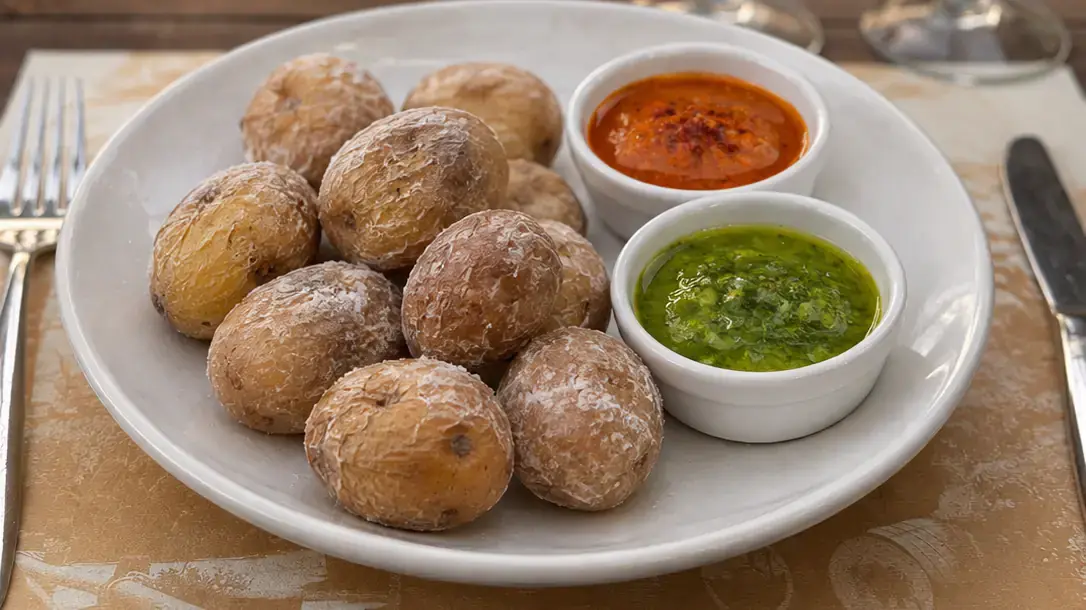
What papas arrugadas are
They're small potatoes boiled in their skins in very salty water, and that's all. When they're done, the water is drained off and they're left in the pan over the heat for a few minutes, with the lid off. The water that's left evaporates, the salt sticks to the skins in a white crust, and the skins wrinkle. Hence the name: arrugadas means wrinkled.
You don't peel them: you eat the skin. Inside, the potato is tender and slightly creamy. Outside, it's salty. That contrast is the whole dish.
In the Canaries nobody says patata, the usual Spanish word. They say papa, the word that came over from the Americas. And the islands had potatoes very early on: there are records of them being shipped from Gran Canaria to Antwerp in 1567, and grown in Tenerife in 1574.
Why seawater and coarse salt
The traditional recipe used seawater. It made sense: on the islands fresh water was scarce and expensive, and seawater already had the salt you needed. Today nearly every kitchen uses fresh water with plenty of coarse salt, which gives the same result without a trip to the beach with a bucket.
The amount of salt is alarming the first time. That's normal: most of it stays in the water and the pan, and only the thin layer on the skin reaches the potato.
Which potato is used
For papas arrugadas you want a small potato with a thin skin and firm flesh. In the Canaries the most prized are the papas antiguas, the old varieties that have been grown on the islands for centuries. Since 2012 they've had Protected Designation of Origin status as Papas Antiguas de Canarias, which covers 29 varieties. For papas arrugadas, Turismo de Tenerife names the negras, the bonitas and the azucenas as the favourites.
The two mojos, which taste nothing alike
Mojo is the Canary Islands' signature sauce. Two usually come with the potatoes:
- Mojo rojo, or picón. Peppers, vinegar, olive oil, garlic, cumin, salt and paprika. It's strong and can be spicy, depending on who makes it.
- Mojo verde. Made with parsley and coriander. It's milder and fresher.
The rule at a Canarian table is simple: you try both and make up your own mind. Some people dip one potato in each, and some mix them on the plate.
A papa arrugada without mojo is only half a papa arrugada.
How to eat them
- Whole or cut in half, with the skin on.
- With a fork or with your fingers, whichever you prefer. In a Canarian home you'll see both.
- Dipped in the sauce, rather than with the sauce poured over the lot: that way each potato tastes the way you want.
- As a side with fish, meat or cheese, or on their own, with the wine.
How we serve them at El Molino Blanco
On our menu papas arrugadas are a side: Canarian potatoes boiled in sea salt, €5, and they always come with mojo. You can order them with any dish. They also come with the rabbit legs (€25), which are served with Canarian potatoes and white mojo.
If it's your first time, order them to share at the start of dinner, while everything else is on its way. It's the easiest way to see why, on the islands, there's never a table without a plate of papas.
Where this comes from
- How they're cooked and the two mojos: Turespaña, Canary Islands cuisine on spain.info (opens in a new tab), checked on 10 November 2026.
- Varieties, the history of the potato on the islands and the favourite potatoes for papas arrugadas: Turismo de Tenerife, “Papas antiguas de Tenerife” fact sheet (opens in a new tab), checked on 10 November 2026.
- Protected Designation of Origin Papas Antiguas de Canarias: Commission Implementing Regulation (EU) No 1005/2012 of 25 October 2012, Official Journal of the EU L 302 (opens in a new tab).
- Dishes, prices and descriptions: El Molino Blanco menu, winter 2026–27.
If anything here has changed, tell us at the table or on +34 620 77 00 72 and we'll put it right, with the source in front of us.
Try them next to the windmill
Papas arrugadas are on the menu as a side, at €5. We're open every day from 5pm to midnight.